Enum LabelAreaPosition
pub enum LabelAreaPosition {
    Top = 0,
    Bottom = 1,
    Left = 2,
    Right = 3,
}
Expand description
Specifies one of the four label positions around the figure.
This is used to configure the label area size with function
ChartBuilder::set_label_area_size().
§Example
use plotters::prelude::*;
let drawing_area = SVGBackend::new("label_area_position.svg", (300, 200)).into_drawing_area();
drawing_area.fill(&WHITE).unwrap();
let mut chart_builder = ChartBuilder::on(&drawing_area);
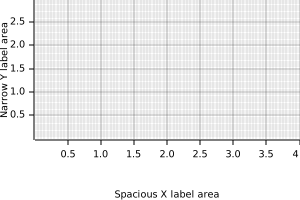
chart_builder.set_label_area_size(LabelAreaPosition::Bottom, 60).set_label_area_size(LabelAreaPosition::Left, 35);
let mut chart_context = chart_builder.build_cartesian_2d(0.0..4.0, 0.0..3.0).unwrap();
chart_context.configure_mesh().x_desc("Spacious X label area").y_desc("Narrow Y label area").draw().unwrap();
The result is a chart with a spacious X label area and a narrow Y label area:
§See also
Variants§
Top = 0
Top of the figure
Bottom = 1
Bottom of the figure
Left = 2
Left side of the figure
Right = 3
Right side of the figure
Trait Implementations§
§impl Clone for LabelAreaPosition
impl Clone for LabelAreaPosition
§fn clone(&self) -> LabelAreaPosition
fn clone(&self) -> LabelAreaPosition
Returns a duplicate of the value. Read more
1.0.0 · Source§fn clone_from(&mut self, source: &Self)
fn clone_from(&mut self, source: &Self)
Performs copy-assignment from
source. Read moreimpl Copy for LabelAreaPosition
Auto Trait Implementations§
impl Freeze for LabelAreaPosition
impl RefUnwindSafe for LabelAreaPosition
impl Send for LabelAreaPosition
impl Sync for LabelAreaPosition
impl Unpin for LabelAreaPosition
impl UnwindSafe for LabelAreaPosition
Blanket Implementations§
Source§impl<T> BorrowMut<T> for Twhere
T: ?Sized,
impl<T> BorrowMut<T> for Twhere
T: ?Sized,
Source§fn borrow_mut(&mut self) -> &mut T
fn borrow_mut(&mut self) -> &mut T
Mutably borrows from an owned value. Read more
Source§impl<T> CloneToUninit for Twhere
T: Clone,
impl<T> CloneToUninit for Twhere
T: Clone,
§impl<T> Downcast for Twhere
T: Any,
impl<T> Downcast for Twhere
T: Any,
§fn into_any(self: Box<T>) -> Box<dyn Any>
fn into_any(self: Box<T>) -> Box<dyn Any>
Convert
Box<dyn Trait> (where Trait: Downcast) to Box<dyn Any>. Box<dyn Any> can
then be further downcast into Box<ConcreteType> where ConcreteType implements Trait.§fn into_any_rc(self: Rc<T>) -> Rc<dyn Any>
fn into_any_rc(self: Rc<T>) -> Rc<dyn Any>
Convert
Rc<Trait> (where Trait: Downcast) to Rc<Any>. Rc<Any> can then be
further downcast into Rc<ConcreteType> where ConcreteType implements Trait.§fn as_any(&self) -> &(dyn Any + 'static)
fn as_any(&self) -> &(dyn Any + 'static)
Convert
&Trait (where Trait: Downcast) to &Any. This is needed since Rust cannot
generate &Any’s vtable from &Trait’s.§fn as_any_mut(&mut self) -> &mut (dyn Any + 'static)
fn as_any_mut(&mut self) -> &mut (dyn Any + 'static)
Convert
&mut Trait (where Trait: Downcast) to &Any. This is needed since Rust cannot
generate &mut Any’s vtable from &mut Trait’s.§impl<T> DowncastSync for T
impl<T> DowncastSync for T
§impl<T> Instrument for T
impl<T> Instrument for T
§fn instrument(self, span: Span) -> Instrumented<Self>
fn instrument(self, span: Span) -> Instrumented<Self>
§fn in_current_span(self) -> Instrumented<Self>
fn in_current_span(self) -> Instrumented<Self>
Source§impl<T> IntoEither for T
impl<T> IntoEither for T
Source§fn into_either(self, into_left: bool) -> Either<Self, Self>
fn into_either(self, into_left: bool) -> Either<Self, Self>
Converts
self into a Left variant of Either<Self, Self>
if into_left is true.
Converts self into a Right variant of Either<Self, Self>
otherwise. Read moreSource§fn into_either_with<F>(self, into_left: F) -> Either<Self, Self>
fn into_either_with<F>(self, into_left: F) -> Either<Self, Self>
Converts
self into a Left variant of Either<Self, Self>
if into_left(&self) returns true.
Converts self into a Right variant of Either<Self, Self>
otherwise. Read more