Struct ChartContext
pub struct ChartContext<'a, DB, CT>where
    DB: DrawingBackend,
    CT: CoordTranslate,{ /* private fields */ }
Expand description
The context of the chart. This is the core object of Plotters.
Any plot/chart is abstracted as this type, and any data series can be placed to the chart context.
- To draw a series on a chart context, use
ChartContext::draw_series(). - To draw a single element on the chart, you may want to use
ChartContext::plotting_area().
See crate::series::LineSeries and ChartContext::configure_series_labels() for more information and examples
Implementations§
§impl<'a, DB, XT, YT, X, Y> ChartContext<'a, DB, Cartesian2d<X, Y>>where
DB: DrawingBackend,
X: Ranged<ValueType = XT> + ValueFormatter<XT>,
Y: Ranged<ValueType = YT> + ValueFormatter<YT>,
impl<'a, DB, XT, YT, X, Y> ChartContext<'a, DB, Cartesian2d<X, Y>>where
DB: DrawingBackend,
X: Ranged<ValueType = XT> + ValueFormatter<XT>,
Y: Ranged<ValueType = YT> + ValueFormatter<YT>,
pub fn configure_mesh(&mut self) -> MeshStyle<'a, '_, X, Y, DB>
pub fn configure_mesh(&mut self) -> MeshStyle<'a, '_, X, Y, DB>
Initialize a mesh configuration object and mesh drawing can be finalized by calling
the function MeshStyle::draw.
§impl<'a, DB, X, Y> ChartContext<'a, DB, Cartesian2d<X, Y>>
impl<'a, DB, X, Y> ChartContext<'a, DB, Cartesian2d<X, Y>>
§impl<'a, DB, X, Y> ChartContext<'a, DB, Cartesian2d<X, Y>>
impl<'a, DB, X, Y> ChartContext<'a, DB, Cartesian2d<X, Y>>
pub fn set_secondary_coord<SX, SY>(
self,
x_coord: SX,
y_coord: SY,
) -> DualCoordChartContext<'a, DB, Cartesian2d<X, Y>, Cartesian2d<<SX as AsRangedCoord>::CoordDescType, <SY as AsRangedCoord>::CoordDescType>>where
SX: AsRangedCoord,
SY: AsRangedCoord,
pub fn set_secondary_coord<SX, SY>(
self,
x_coord: SX,
y_coord: SY,
) -> DualCoordChartContext<'a, DB, Cartesian2d<X, Y>, Cartesian2d<<SX as AsRangedCoord>::CoordDescType, <SY as AsRangedCoord>::CoordDescType>>where
SX: AsRangedCoord,
SY: AsRangedCoord,
Convert this chart context into a dual axis chart context and attach a second coordinate spec on the chart context. For more detailed information, see documentation for struct DualCoordChartContext
x_coord: The coordinate spec for the X axisy_coord: The coordinate spec for the Y axis- returns The newly created dual spec chart context
§impl<'a, DB, X, Y, Z, XT, YT, ZT> ChartContext<'a, DB, Cartesian3d<X, Y, Z>>where
DB: DrawingBackend,
X: Ranged<ValueType = XT> + ValueFormatter<XT>,
Y: Ranged<ValueType = YT> + ValueFormatter<YT>,
Z: Ranged<ValueType = ZT> + ValueFormatter<ZT>,
impl<'a, DB, X, Y, Z, XT, YT, ZT> ChartContext<'a, DB, Cartesian3d<X, Y, Z>>where
DB: DrawingBackend,
X: Ranged<ValueType = XT> + ValueFormatter<XT>,
Y: Ranged<ValueType = YT> + ValueFormatter<YT>,
Z: Ranged<ValueType = ZT> + ValueFormatter<ZT>,
pub fn configure_axes(&mut self) -> Axes3dStyle<'a, '_, X, Y, Z, DB>
pub fn configure_axes(&mut self) -> Axes3dStyle<'a, '_, X, Y, Z, DB>
Create an axis configuration object, to set line styles, labels, sizes, etc.
Default values for axis configuration are set by function Axes3dStyle::new().
§Example
use plotters::prelude::*;
let drawing_area = SVGBackend::new("configure_axes.svg", (300, 200)).into_drawing_area();
drawing_area.fill(&WHITE).unwrap();
let mut chart_builder = ChartBuilder::on(&drawing_area);
let mut chart_context = chart_builder.margin_bottom(30).build_cartesian_3d(0.0..4.0, 0.0..3.0, 0.0..2.7).unwrap();
chart_context.configure_axes().tick_size(8).x_labels(4).y_labels(3).z_labels(2)
    .max_light_lines(5).axis_panel_style(GREEN.mix(0.1)).bold_grid_style(BLUE.mix(0.3))
    .light_grid_style(BLUE.mix(0.2)).label_style(("Calibri", 10))
    .x_formatter(&|x| format!("x={x}")).draw().unwrap();
The resulting chart reflects the customizations specified through configure_axes():
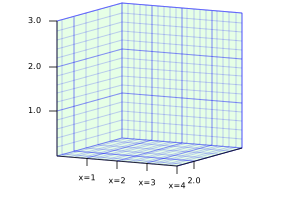
All these customizations are Axes3dStyle methods.
In the chart, tick_size(8) produces tick marks 8 pixels long. You can use
(5u32).percent().max(5).in_pixels(chart.plotting_area() to tell Plotters to calculate the tick mark
size as a percentage of the dimensions of the figure. See crate::style::RelativeSize and
crate::style::SizeDesc for more information.
x_labels(4) specifies a maximum of 4
tick marks and labels in the X axis. max_light_lines(5) specifies a maximum of 5 minor grid lines
between any two tick marks. axis_panel_style(GREEN.mix(0.1)) specifies the style of the panels in
the background, a light green color. bold_grid_style(BLUE.mix(0.3)) and light_grid_style(BLUE.mix(0.2))
specify the style of the major and minor grid lines, respectively. label_style() specifies the text
style of the axis labels, and x_formatter(|x| format!("x={x}")) specifies the string format of the X
axis labels.
§See also
ChartContext::configure_mesh(), a similar function for 2D plots
§impl<'a, DB, X, Y, Z> ChartContext<'a, DB, Cartesian3d<X, Y, Z>>
impl<'a, DB, X, Y, Z> ChartContext<'a, DB, Cartesian3d<X, Y, Z>>
pub fn with_projection<P>(
&mut self,
pf: P,
) -> &mut ChartContext<'a, DB, Cartesian3d<X, Y, Z>>
pub fn with_projection<P>( &mut self, pf: P, ) -> &mut ChartContext<'a, DB, Cartesian3d<X, Y, Z>>
Override the 3D projection matrix. This function allows to override the default projection matrix.
pf: A function that takes the default projection matrix configuration and returns the projection matrix. This function will allow you to adjust the pitch, yaw angle and the centeral point of the projection, etc. You can also build a projection matrix which is not relies on the default configuration as well.
pub fn set_3d_pixel_range(
&mut self,
size: (i32, i32, i32),
) -> &mut ChartContext<'a, DB, Cartesian3d<X, Y, Z>>
pub fn set_3d_pixel_range( &mut self, size: (i32, i32, i32), ) -> &mut ChartContext<'a, DB, Cartesian3d<X, Y, Z>>
Sets the 3d coordinate pixel range.
§impl<'a, DB, CT> ChartContext<'a, DB, CT>where
DB: DrawingBackend,
CT: ReverseCoordTranslate,
impl<'a, DB, CT> ChartContext<'a, DB, CT>where
DB: DrawingBackend,
CT: ReverseCoordTranslate,
pub fn into_coord_trans(self) -> impl Fn((i32, i32))
pub fn into_coord_trans(self) -> impl Fn((i32, i32))
Convert the chart context into an closure that can be used for coordinate translation
§impl<'a, DB, CT> ChartContext<'a, DB, CT>where
DB: DrawingBackend,
CT: CoordTranslate,
impl<'a, DB, CT> ChartContext<'a, DB, CT>where
DB: DrawingBackend,
CT: CoordTranslate,
pub fn configure_series_labels<'b>(
&'b mut self,
) -> SeriesLabelStyle<'a, 'b, DB, CT>where
DB: 'a,
pub fn configure_series_labels<'b>(
&'b mut self,
) -> SeriesLabelStyle<'a, 'b, DB, CT>where
DB: 'a,
Configure the styles for drawing series labels in the chart
§Example
use plotters::prelude::*;
let data = [(1.0, 3.3), (2., 2.1), (3., 1.5), (4., 1.9), (5., 1.0)];
let drawing_area = SVGBackend::new("configure_series_labels.svg", (300, 200)).into_drawing_area();
drawing_area.fill(&WHITE).unwrap();
let mut chart_builder = ChartBuilder::on(&drawing_area);
chart_builder.margin(7).set_left_and_bottom_label_area_size(20);
let mut chart_context = chart_builder.build_cartesian_2d(0.0..5.5, 0.0..5.5).unwrap();
chart_context.configure_mesh().draw().unwrap();
chart_context.draw_series(LineSeries::new(data, BLACK)).unwrap().label("Series 1")
    .legend(|(x,y)| Rectangle::new([(x - 15, y + 1), (x, y)], BLACK));
chart_context.configure_series_labels().position(SeriesLabelPosition::UpperRight).margin(20)
    .legend_area_size(5).border_style(BLUE).background_style(BLUE.mix(0.1)).label_font(("Calibri", 20)).draw().unwrap();
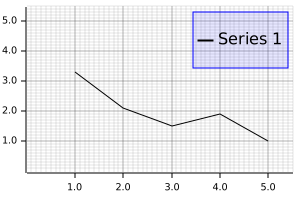
The result is a chart with one data series labeled “Series 1” in a blue legend box:
§See also
See crate::series::LineSeries for more information and examples
pub fn plotting_area(&self) -> &DrawingArea<DB, CT>
pub fn plotting_area(&self) -> &DrawingArea<DB, CT>
Get a reference of underlying plotting area
pub fn as_coord_spec(&self) -> &CT
pub fn as_coord_spec(&self) -> &CT
Cast the reference to a chart context to a reference to underlying coordinate specification.
pub fn draw_series<B, E, R, S>(
&mut self,
series: S,
) -> Result<&mut SeriesAnno<'a, DB>, DrawingAreaErrorKind<<DB as DrawingBackend>::ErrorType>>where
B: CoordMapper,
&'b E: for<'b> PointCollection<'b, <CT as CoordTranslate>::From, B>,
E: Drawable<DB, B>,
R: Borrow<E>,
S: IntoIterator<Item = R>,
pub fn draw_series<B, E, R, S>(
&mut self,
series: S,
) -> Result<&mut SeriesAnno<'a, DB>, DrawingAreaErrorKind<<DB as DrawingBackend>::ErrorType>>where
B: CoordMapper,
&'b E: for<'b> PointCollection<'b, <CT as CoordTranslate>::From, B>,
E: Drawable<DB, B>,
R: Borrow<E>,
S: IntoIterator<Item = R>,
Draws a data series. A data series in Plotters is abstracted as an iterator of elements.
See crate::series::LineSeries and ChartContext::configure_series_labels() for more information and examples.
§impl<'a, DB, CT> ChartContext<'a, DB, CT>where
DB: DrawingBackend,
CT: CoordTranslate,
impl<'a, DB, CT> ChartContext<'a, DB, CT>where
DB: DrawingBackend,
CT: CoordTranslate,
pub fn into_chart_state(self) -> ChartState<CT>
pub fn into_chart_state(self) -> ChartState<CT>
Convert a chart context into a chart state, by doing so, the chart context is consumed and
a saved chart state is created for later use. This is typically used in incremental rendering. See documentation of ChartState for more detailed example.
Convert the chart context into a sharable chart state.
Normally a chart state can not be clone, since the coordinate spec may not be able to be
cloned. In this case, we can use an Arc get the coordinate wrapped thus the state can be
cloned and shared by multiple chart context
§impl<'a, DB, CT> ChartContext<'a, DB, CT>
impl<'a, DB, CT> ChartContext<'a, DB, CT>
pub fn to_chart_state(&self) -> ChartState<CT>
pub fn to_chart_state(&self) -> ChartState<CT>
Make the chart context, do not consume the chart context and clone the coordinate spec
Trait Implementations§
§impl<'a, DB, CT1, CT2> Borrow<ChartContext<'a, DB, CT1>> for DualCoordChartContext<'a, DB, CT1, CT2>
impl<'a, DB, CT1, CT2> Borrow<ChartContext<'a, DB, CT1>> for DualCoordChartContext<'a, DB, CT1, CT2>
§fn borrow(&self) -> &ChartContext<'a, DB, CT1>
fn borrow(&self) -> &ChartContext<'a, DB, CT1>
§impl<'a, DB, CT1, CT2> BorrowMut<ChartContext<'a, DB, CT1>> for DualCoordChartContext<'a, DB, CT1, CT2>
impl<'a, DB, CT1, CT2> BorrowMut<ChartContext<'a, DB, CT1>> for DualCoordChartContext<'a, DB, CT1, CT2>
§fn borrow_mut(&mut self) -> &mut ChartContext<'a, DB, CT1>
fn borrow_mut(&mut self) -> &mut ChartContext<'a, DB, CT1>
§impl<'a, DB, CT> From<&ChartContext<'a, DB, CT>> for ChartState<CT>
impl<'a, DB, CT> From<&ChartContext<'a, DB, CT>> for ChartState<CT>
§fn from(chart: &ChartContext<'a, DB, CT>) -> ChartState<CT>
fn from(chart: &ChartContext<'a, DB, CT>) -> ChartState<CT>
§impl<'a, DB, CT> From<ChartContext<'a, DB, CT>> for ChartState<CT>where
DB: DrawingBackend,
CT: CoordTranslate,
impl<'a, DB, CT> From<ChartContext<'a, DB, CT>> for ChartState<CT>where
DB: DrawingBackend,
CT: CoordTranslate,
§fn from(chart: ChartContext<'a, DB, CT>) -> ChartState<CT>
fn from(chart: ChartContext<'a, DB, CT>) -> ChartState<CT>
Auto Trait Implementations§
impl<'a, DB, CT> Freeze for ChartContext<'a, DB, CT>where
CT: Freeze,
impl<'a, DB, CT> !RefUnwindSafe for ChartContext<'a, DB, CT>
impl<'a, DB, CT> !Send for ChartContext<'a, DB, CT>
impl<'a, DB, CT> !Sync for ChartContext<'a, DB, CT>
impl<'a, DB, CT> Unpin for ChartContext<'a, DB, CT>where
CT: Unpin,
impl<'a, DB, CT> !UnwindSafe for ChartContext<'a, DB, CT>
Blanket Implementations§
Source§impl<T> BorrowMut<T> for Twhere
T: ?Sized,
impl<T> BorrowMut<T> for Twhere
T: ?Sized,
Source§fn borrow_mut(&mut self) -> &mut T
fn borrow_mut(&mut self) -> &mut T
§impl<T> Downcast for Twhere
T: Any,
impl<T> Downcast for Twhere
T: Any,
§fn into_any(self: Box<T>) -> Box<dyn Any>
fn into_any(self: Box<T>) -> Box<dyn Any>
Box<dyn Trait> (where Trait: Downcast) to Box<dyn Any>. Box<dyn Any> can
then be further downcast into Box<ConcreteType> where ConcreteType implements Trait.§fn into_any_rc(self: Rc<T>) -> Rc<dyn Any>
fn into_any_rc(self: Rc<T>) -> Rc<dyn Any>
Rc<Trait> (where Trait: Downcast) to Rc<Any>. Rc<Any> can then be
further downcast into Rc<ConcreteType> where ConcreteType implements Trait.§fn as_any(&self) -> &(dyn Any + 'static)
fn as_any(&self) -> &(dyn Any + 'static)
&Trait (where Trait: Downcast) to &Any. This is needed since Rust cannot
generate &Any’s vtable from &Trait’s.§fn as_any_mut(&mut self) -> &mut (dyn Any + 'static)
fn as_any_mut(&mut self) -> &mut (dyn Any + 'static)
&mut Trait (where Trait: Downcast) to &Any. This is needed since Rust cannot
generate &mut Any’s vtable from &mut Trait’s.§impl<T> Instrument for T
impl<T> Instrument for T
§fn instrument(self, span: Span) -> Instrumented<Self>
fn instrument(self, span: Span) -> Instrumented<Self>
§fn in_current_span(self) -> Instrumented<Self>
fn in_current_span(self) -> Instrumented<Self>
Source§impl<T> IntoEither for T
impl<T> IntoEither for T
Source§fn into_either(self, into_left: bool) -> Either<Self, Self>
fn into_either(self, into_left: bool) -> Either<Self, Self>
self into a Left variant of Either<Self, Self>
if into_left is true.
Converts self into a Right variant of Either<Self, Self>
otherwise. Read moreSource§fn into_either_with<F>(self, into_left: F) -> Either<Self, Self>
fn into_either_with<F>(self, into_left: F) -> Either<Self, Self>
self into a Left variant of Either<Self, Self>
if into_left(&self) returns true.
Converts self into a Right variant of Either<Self, Self>
otherwise. Read more