Struct Histogram
pub struct Histogram<'a, BR, A, Tag = Vertical>{ /* private fields */ }Expand description
Presents data in a histogram. Input data can be raw or aggregated.
§Examples
use plotters::prelude::*;
let data = [1, 1, 2, 2, 1, 3, 3, 2, 2, 1, 1, 2, 2, 2, 3, 3, 1, 2, 3];
let drawing_area = SVGBackend::new("histogram_vertical.svg", (300, 200)).into_drawing_area();
drawing_area.fill(&WHITE).unwrap();
let mut chart_builder = ChartBuilder::on(&drawing_area);
chart_builder.margin(5).set_left_and_bottom_label_area_size(20);
let mut chart_context = chart_builder.build_cartesian_2d((1..3).into_segmented(), 0..9).unwrap();
chart_context.configure_mesh().draw().unwrap();
chart_context.draw_series(Histogram::vertical(&chart_context).style(BLUE.filled()).margin(10)
    .data(data.map(|x| (x, 1)))).unwrap();
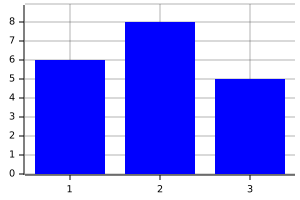
The result is a histogram counting the occurrences of 1, 2, and 3 in data:
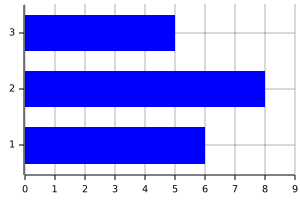
Here is a variation with Histogram::horizontal(), replacing (1..3).into_segmented(), 0..9 with
0..9, (1..3).into_segmented():
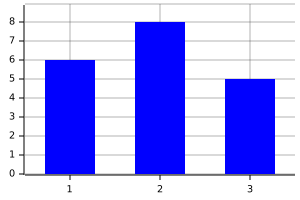
The spacing between histogram bars is adjusted with Histogram::margin().
Here is a version of the figure where .margin(10) has been replaced by .margin(20);
the resulting bars are narrow and more spaced:
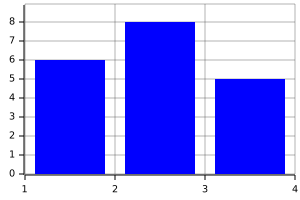
crate::coord::ranged1d::IntoSegmentedCoord::into_segmented() is useful for discrete data; it makes sure the histogram bars
are centered on each data value. Here is another variation with (1..3).into_segmented()
replaced by 1..4:
Histogram::style() sets the style of the bars. Here is a histogram without .filled():
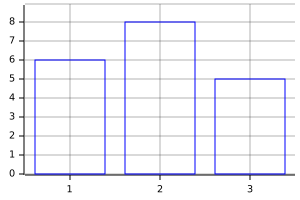
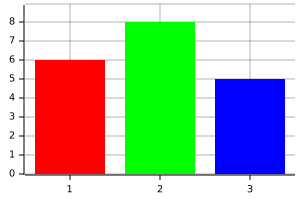
The following version uses Histogram::style_func() for finer control. Let’s replace .style(BLUE.filled()) with
.style_func(|x, _bar_height| if let SegmentValue::Exact(v) = x {[BLACK, RED, GREEN, BLUE][*v as usize].filled()} else {BLACK.filled()}).
The resulting bars come in different colors:
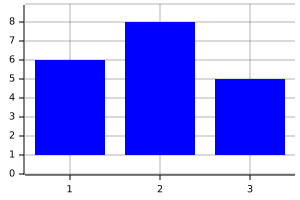
Histogram::baseline() adjusts the base of the bars. The following figure adds .baseline(1)
to the right of .margin(10). The lower portion of the bars are removed:
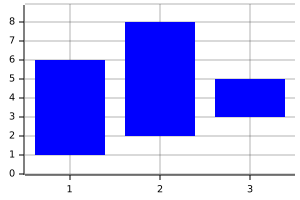
The following figure uses Histogram::baseline_func() for finer control. Let’s add
.baseline_func(|x| if let SegmentValue::Exact(v) = x {*v as i32} else {0})
to the right of .margin(10). The lower portion of the bars are removed; the removed portion is taller
to the right:
Implementations§
§impl<'a, BR, A, Tag> Histogram<'a, BR, A, Tag>
impl<'a, BR, A, Tag> Histogram<'a, BR, A, Tag>
pub fn style<S>(self, style: S) -> Histogram<'a, BR, A, Tag> ⓘwhere
S: Into<ShapeStyle>,
pub fn style<S>(self, style: S) -> Histogram<'a, BR, A, Tag> ⓘwhere
S: Into<ShapeStyle>,
Sets the style of the histogram bars.
See Histogram for more information and examples.
pub fn style_func(
self,
style_func: impl Fn(&<BR as Ranged>::ValueType, &A) -> ShapeStyle + 'a,
) -> Histogram<'a, BR, A, Tag> ⓘ
pub fn style_func( self, style_func: impl Fn(&<BR as Ranged>::ValueType, &A) -> ShapeStyle + 'a, ) -> Histogram<'a, BR, A, Tag> ⓘ
Sets the style of histogram using a closure.
The closure takes the position of the bar in guest coordinates as argument.
The argument may need some processing if the data range has been transformed by
crate::coord::ranged1d::IntoSegmentedCoord::into_segmented() as shown in the Histogram example.
pub fn baseline(self, baseline: A) -> Histogram<'a, BR, A, Tag> ⓘwhere
A: Clone,
pub fn baseline(self, baseline: A) -> Histogram<'a, BR, A, Tag> ⓘwhere
A: Clone,
Sets the baseline of the histogram.
See Histogram for more information and examples.
pub fn baseline_func(
self,
func: impl Fn(&<BR as Ranged>::ValueType) -> A + 'a,
) -> Histogram<'a, BR, A, Tag> ⓘ
pub fn baseline_func( self, func: impl Fn(&<BR as Ranged>::ValueType) -> A + 'a, ) -> Histogram<'a, BR, A, Tag> ⓘ
Sets the histogram bar baselines using a closure.
The closure takes the bar position and height as argument.
The argument may need some processing if the data range has been transformed by
crate::coord::ranged1d::IntoSegmentedCoord::into_segmented() as shown in the Histogram example.
§impl<'a, BR, A> Histogram<'a, BR, A>
impl<'a, BR, A> Histogram<'a, BR, A>
pub fn vertical<ACoord, DB>(
parent: &ChartContext<'_, DB, Cartesian2d<BR, ACoord>>,
) -> Histogram<'a, BR, A> ⓘwhere
DB: DrawingBackend + 'a,
ACoord: Ranged<ValueType = A>,
pub fn vertical<ACoord, DB>(
parent: &ChartContext<'_, DB, Cartesian2d<BR, ACoord>>,
) -> Histogram<'a, BR, A> ⓘwhere
DB: DrawingBackend + 'a,
ACoord: Ranged<ValueType = A>,
Creates a vertical histogram.
See Histogram for more information and examples.
§impl<'a, BR, A> Histogram<'a, BR, A, Horizontal>
impl<'a, BR, A> Histogram<'a, BR, A, Horizontal>
pub fn horizontal<ACoord, DB>(
parent: &ChartContext<'_, DB, Cartesian2d<ACoord, BR>>,
) -> Histogram<'a, BR, A, Horizontal> ⓘwhere
DB: DrawingBackend,
ACoord: Ranged<ValueType = A>,
pub fn horizontal<ACoord, DB>(
parent: &ChartContext<'_, DB, Cartesian2d<ACoord, BR>>,
) -> Histogram<'a, BR, A, Horizontal> ⓘwhere
DB: DrawingBackend,
ACoord: Ranged<ValueType = A>,
Creates a horizontal histogram.
See Histogram for more information and examples.
Trait Implementations§
§impl<'a, BR, A> Iterator for Histogram<'a, BR, A>
impl<'a, BR, A> Iterator for Histogram<'a, BR, A>
§fn next(&mut self) -> Option<<Histogram<'a, BR, A> as Iterator>::Item>
fn next(&mut self) -> Option<<Histogram<'a, BR, A> as Iterator>::Item>
Source§fn next_chunk<const N: usize>(
&mut self,
) -> Result<[Self::Item; N], IntoIter<Self::Item, N>>where
Self: Sized,
fn next_chunk<const N: usize>(
&mut self,
) -> Result<[Self::Item; N], IntoIter<Self::Item, N>>where
Self: Sized,
iter_next_chunk)N values. Read more1.0.0 · Source§fn size_hint(&self) -> (usize, Option<usize>)
fn size_hint(&self) -> (usize, Option<usize>)
1.0.0 · Source§fn count(self) -> usizewhere
Self: Sized,
fn count(self) -> usizewhere
Self: Sized,
1.0.0 · Source§fn last(self) -> Option<Self::Item>where
Self: Sized,
fn last(self) -> Option<Self::Item>where
Self: Sized,
Source§fn advance_by(&mut self, n: usize) -> Result<(), NonZero<usize>>
fn advance_by(&mut self, n: usize) -> Result<(), NonZero<usize>>
iter_advance_by)n elements. Read more1.0.0 · Source§fn nth(&mut self, n: usize) -> Option<Self::Item>
fn nth(&mut self, n: usize) -> Option<Self::Item>
nth element of the iterator. Read more1.28.0 · Source§fn step_by(self, step: usize) -> StepBy<Self>where
Self: Sized,
fn step_by(self, step: usize) -> StepBy<Self>where
Self: Sized,
1.0.0 · Source§fn chain<U>(self, other: U) -> Chain<Self, <U as IntoIterator>::IntoIter>
fn chain<U>(self, other: U) -> Chain<Self, <U as IntoIterator>::IntoIter>
1.0.0 · Source§fn zip<U>(self, other: U) -> Zip<Self, <U as IntoIterator>::IntoIter>where
Self: Sized,
U: IntoIterator,
fn zip<U>(self, other: U) -> Zip<Self, <U as IntoIterator>::IntoIter>where
Self: Sized,
U: IntoIterator,
Source§fn intersperse(self, separator: Self::Item) -> Intersperse<Self>
fn intersperse(self, separator: Self::Item) -> Intersperse<Self>
iter_intersperse)separator between adjacent
items of the original iterator. Read moreSource§fn intersperse_with<G>(self, separator: G) -> IntersperseWith<Self, G>
fn intersperse_with<G>(self, separator: G) -> IntersperseWith<Self, G>
iter_intersperse)separator
between adjacent items of the original iterator. Read more1.0.0 · Source§fn map<B, F>(self, f: F) -> Map<Self, F>
fn map<B, F>(self, f: F) -> Map<Self, F>
1.0.0 · Source§fn filter<P>(self, predicate: P) -> Filter<Self, P>
fn filter<P>(self, predicate: P) -> Filter<Self, P>
1.0.0 · Source§fn filter_map<B, F>(self, f: F) -> FilterMap<Self, F>
fn filter_map<B, F>(self, f: F) -> FilterMap<Self, F>
1.0.0 · Source§fn enumerate(self) -> Enumerate<Self>where
Self: Sized,
fn enumerate(self) -> Enumerate<Self>where
Self: Sized,
1.0.0 · Source§fn skip_while<P>(self, predicate: P) -> SkipWhile<Self, P>
fn skip_while<P>(self, predicate: P) -> SkipWhile<Self, P>
1.0.0 · Source§fn take_while<P>(self, predicate: P) -> TakeWhile<Self, P>
fn take_while<P>(self, predicate: P) -> TakeWhile<Self, P>
1.57.0 · Source§fn map_while<B, P>(self, predicate: P) -> MapWhile<Self, P>
fn map_while<B, P>(self, predicate: P) -> MapWhile<Self, P>
1.0.0 · Source§fn skip(self, n: usize) -> Skip<Self>where
Self: Sized,
fn skip(self, n: usize) -> Skip<Self>where
Self: Sized,
n elements. Read more1.0.0 · Source§fn take(self, n: usize) -> Take<Self>where
Self: Sized,
fn take(self, n: usize) -> Take<Self>where
Self: Sized,
n elements, or fewer
if the underlying iterator ends sooner. Read more1.0.0 · Source§fn flat_map<U, F>(self, f: F) -> FlatMap<Self, U, F>
fn flat_map<U, F>(self, f: F) -> FlatMap<Self, U, F>
1.29.0 · Source§fn flatten(self) -> Flatten<Self>
fn flatten(self) -> Flatten<Self>
Source§fn map_windows<F, R, const N: usize>(self, f: F) -> MapWindows<Self, F, N>
fn map_windows<F, R, const N: usize>(self, f: F) -> MapWindows<Self, F, N>
iter_map_windows)f for each contiguous window of size N over
self and returns an iterator over the outputs of f. Like slice::windows(),
the windows during mapping overlap as well. Read more1.0.0 · Source§fn inspect<F>(self, f: F) -> Inspect<Self, F>
fn inspect<F>(self, f: F) -> Inspect<Self, F>
1.0.0 · Source§fn by_ref(&mut self) -> &mut Selfwhere
Self: Sized,
fn by_ref(&mut self) -> &mut Selfwhere
Self: Sized,
Iterator. Read moreSource§fn try_collect<B>(
&mut self,
) -> <<Self::Item as Try>::Residual as Residual<B>>::TryType
fn try_collect<B>( &mut self, ) -> <<Self::Item as Try>::Residual as Residual<B>>::TryType
iterator_try_collect)Source§fn collect_into<E>(self, collection: &mut E) -> &mut E
fn collect_into<E>(self, collection: &mut E) -> &mut E
iter_collect_into)1.0.0 · Source§fn partition<B, F>(self, f: F) -> (B, B)
fn partition<B, F>(self, f: F) -> (B, B)
Source§fn partition_in_place<'a, T, P>(self, predicate: P) -> usize
fn partition_in_place<'a, T, P>(self, predicate: P) -> usize
iter_partition_in_place)true precede all those that return false.
Returns the number of true elements found. Read moreSource§fn is_partitioned<P>(self, predicate: P) -> bool
fn is_partitioned<P>(self, predicate: P) -> bool
iter_is_partitioned)true precede all those that return false. Read more1.27.0 · Source§fn try_fold<B, F, R>(&mut self, init: B, f: F) -> R
fn try_fold<B, F, R>(&mut self, init: B, f: F) -> R
1.27.0 · Source§fn try_for_each<F, R>(&mut self, f: F) -> R
fn try_for_each<F, R>(&mut self, f: F) -> R
1.0.0 · Source§fn fold<B, F>(self, init: B, f: F) -> B
fn fold<B, F>(self, init: B, f: F) -> B
1.51.0 · Source§fn reduce<F>(self, f: F) -> Option<Self::Item>
fn reduce<F>(self, f: F) -> Option<Self::Item>
Source§fn try_reduce<R>(
&mut self,
f: impl FnMut(Self::Item, Self::Item) -> R,
) -> <<R as Try>::Residual as Residual<Option<<R as Try>::Output>>>::TryType
fn try_reduce<R>( &mut self, f: impl FnMut(Self::Item, Self::Item) -> R, ) -> <<R as Try>::Residual as Residual<Option<<R as Try>::Output>>>::TryType
iterator_try_reduce)1.0.0 · Source§fn all<F>(&mut self, f: F) -> bool
fn all<F>(&mut self, f: F) -> bool
1.0.0 · Source§fn any<F>(&mut self, f: F) -> bool
fn any<F>(&mut self, f: F) -> bool
1.0.0 · Source§fn find<P>(&mut self, predicate: P) -> Option<Self::Item>
fn find<P>(&mut self, predicate: P) -> Option<Self::Item>
1.30.0 · Source§fn find_map<B, F>(&mut self, f: F) -> Option<B>
fn find_map<B, F>(&mut self, f: F) -> Option<B>
Source§fn try_find<R>(
&mut self,
f: impl FnMut(&Self::Item) -> R,
) -> <<R as Try>::Residual as Residual<Option<Self::Item>>>::TryType
fn try_find<R>( &mut self, f: impl FnMut(&Self::Item) -> R, ) -> <<R as Try>::Residual as Residual<Option<Self::Item>>>::TryType
try_find)1.0.0 · Source§fn position<P>(&mut self, predicate: P) -> Option<usize>
fn position<P>(&mut self, predicate: P) -> Option<usize>
1.0.0 · Source§fn rposition<P>(&mut self, predicate: P) -> Option<usize>
fn rposition<P>(&mut self, predicate: P) -> Option<usize>
1.0.0 · Source§fn max(self) -> Option<Self::Item>
fn max(self) -> Option<Self::Item>
1.0.0 · Source§fn min(self) -> Option<Self::Item>
fn min(self) -> Option<Self::Item>
1.6.0 · Source§fn max_by_key<B, F>(self, f: F) -> Option<Self::Item>
fn max_by_key<B, F>(self, f: F) -> Option<Self::Item>
1.15.0 · Source§fn max_by<F>(self, compare: F) -> Option<Self::Item>
fn max_by<F>(self, compare: F) -> Option<Self::Item>
1.6.0 · Source§fn min_by_key<B, F>(self, f: F) -> Option<Self::Item>
fn min_by_key<B, F>(self, f: F) -> Option<Self::Item>
1.15.0 · Source§fn min_by<F>(self, compare: F) -> Option<Self::Item>
fn min_by<F>(self, compare: F) -> Option<Self::Item>
1.0.0 · Source§fn rev(self) -> Rev<Self>where
Self: Sized + DoubleEndedIterator,
fn rev(self) -> Rev<Self>where
Self: Sized + DoubleEndedIterator,
1.0.0 · Source§fn unzip<A, B, FromA, FromB>(self) -> (FromA, FromB)
fn unzip<A, B, FromA, FromB>(self) -> (FromA, FromB)
1.36.0 · Source§fn copied<'a, T>(self) -> Copied<Self>
fn copied<'a, T>(self) -> Copied<Self>
Source§fn array_chunks<const N: usize>(self) -> ArrayChunks<Self, N>where
Self: Sized,
fn array_chunks<const N: usize>(self) -> ArrayChunks<Self, N>where
Self: Sized,
iter_array_chunks)N elements of the iterator at a time. Read more1.11.0 · Source§fn product<P>(self) -> P
fn product<P>(self) -> P
Source§fn cmp_by<I, F>(self, other: I, cmp: F) -> Ordering
fn cmp_by<I, F>(self, other: I, cmp: F) -> Ordering
iter_order_by)Iterator with those
of another with respect to the specified comparison function. Read more1.5.0 · Source§fn partial_cmp<I>(self, other: I) -> Option<Ordering>
fn partial_cmp<I>(self, other: I) -> Option<Ordering>
PartialOrd elements of
this Iterator with those of another. The comparison works like short-circuit
evaluation, returning a result without comparing the remaining elements.
As soon as an order can be determined, the evaluation stops and a result is returned. Read moreSource§fn partial_cmp_by<I, F>(self, other: I, partial_cmp: F) -> Option<Ordering>where
Self: Sized,
I: IntoIterator,
F: FnMut(Self::Item, <I as IntoIterator>::Item) -> Option<Ordering>,
fn partial_cmp_by<I, F>(self, other: I, partial_cmp: F) -> Option<Ordering>where
Self: Sized,
I: IntoIterator,
F: FnMut(Self::Item, <I as IntoIterator>::Item) -> Option<Ordering>,
iter_order_by)Iterator with those
of another with respect to the specified comparison function. Read moreSource§fn eq_by<I, F>(self, other: I, eq: F) -> bool
fn eq_by<I, F>(self, other: I, eq: F) -> bool
iter_order_by)1.5.0 · Source§fn lt<I>(self, other: I) -> bool
fn lt<I>(self, other: I) -> bool
Iterator are lexicographically
less than those of another. Read more1.5.0 · Source§fn le<I>(self, other: I) -> bool
fn le<I>(self, other: I) -> bool
Iterator are lexicographically
less or equal to those of another. Read more1.5.0 · Source§fn gt<I>(self, other: I) -> bool
fn gt<I>(self, other: I) -> bool
Iterator are lexicographically
greater than those of another. Read more1.5.0 · Source§fn ge<I>(self, other: I) -> bool
fn ge<I>(self, other: I) -> bool
Iterator are lexicographically
greater than or equal to those of another. Read more1.82.0 · Source§fn is_sorted(self) -> bool
fn is_sorted(self) -> bool
1.82.0 · Source§fn is_sorted_by<F>(self, compare: F) -> bool
fn is_sorted_by<F>(self, compare: F) -> bool
1.82.0 · Source§fn is_sorted_by_key<F, K>(self, f: F) -> bool
fn is_sorted_by_key<F, K>(self, f: F) -> bool
§impl<'a, BR, A> Iterator for Histogram<'a, BR, A, Horizontal>
impl<'a, BR, A> Iterator for Histogram<'a, BR, A, Horizontal>
§fn next(
&mut self,
) -> Option<<Histogram<'a, BR, A, Horizontal> as Iterator>::Item>
fn next( &mut self, ) -> Option<<Histogram<'a, BR, A, Horizontal> as Iterator>::Item>
Source§fn next_chunk<const N: usize>(
&mut self,
) -> Result<[Self::Item; N], IntoIter<Self::Item, N>>where
Self: Sized,
fn next_chunk<const N: usize>(
&mut self,
) -> Result<[Self::Item; N], IntoIter<Self::Item, N>>where
Self: Sized,
iter_next_chunk)N values. Read more1.0.0 · Source§fn size_hint(&self) -> (usize, Option<usize>)
fn size_hint(&self) -> (usize, Option<usize>)
1.0.0 · Source§fn count(self) -> usizewhere
Self: Sized,
fn count(self) -> usizewhere
Self: Sized,
1.0.0 · Source§fn last(self) -> Option<Self::Item>where
Self: Sized,
fn last(self) -> Option<Self::Item>where
Self: Sized,
Source§fn advance_by(&mut self, n: usize) -> Result<(), NonZero<usize>>
fn advance_by(&mut self, n: usize) -> Result<(), NonZero<usize>>
iter_advance_by)n elements. Read more1.0.0 · Source§fn nth(&mut self, n: usize) -> Option<Self::Item>
fn nth(&mut self, n: usize) -> Option<Self::Item>
nth element of the iterator. Read more1.28.0 · Source§fn step_by(self, step: usize) -> StepBy<Self>where
Self: Sized,
fn step_by(self, step: usize) -> StepBy<Self>where
Self: Sized,
1.0.0 · Source§fn chain<U>(self, other: U) -> Chain<Self, <U as IntoIterator>::IntoIter>
fn chain<U>(self, other: U) -> Chain<Self, <U as IntoIterator>::IntoIter>
1.0.0 · Source§fn zip<U>(self, other: U) -> Zip<Self, <U as IntoIterator>::IntoIter>where
Self: Sized,
U: IntoIterator,
fn zip<U>(self, other: U) -> Zip<Self, <U as IntoIterator>::IntoIter>where
Self: Sized,
U: IntoIterator,
Source§fn intersperse(self, separator: Self::Item) -> Intersperse<Self>
fn intersperse(self, separator: Self::Item) -> Intersperse<Self>
iter_intersperse)separator between adjacent
items of the original iterator. Read moreSource§fn intersperse_with<G>(self, separator: G) -> IntersperseWith<Self, G>
fn intersperse_with<G>(self, separator: G) -> IntersperseWith<Self, G>
iter_intersperse)separator
between adjacent items of the original iterator. Read more1.0.0 · Source§fn map<B, F>(self, f: F) -> Map<Self, F>
fn map<B, F>(self, f: F) -> Map<Self, F>
1.0.0 · Source§fn filter<P>(self, predicate: P) -> Filter<Self, P>
fn filter<P>(self, predicate: P) -> Filter<Self, P>
1.0.0 · Source§fn filter_map<B, F>(self, f: F) -> FilterMap<Self, F>
fn filter_map<B, F>(self, f: F) -> FilterMap<Self, F>
1.0.0 · Source§fn enumerate(self) -> Enumerate<Self>where
Self: Sized,
fn enumerate(self) -> Enumerate<Self>where
Self: Sized,
1.0.0 · Source§fn skip_while<P>(self, predicate: P) -> SkipWhile<Self, P>
fn skip_while<P>(self, predicate: P) -> SkipWhile<Self, P>
1.0.0 · Source§fn take_while<P>(self, predicate: P) -> TakeWhile<Self, P>
fn take_while<P>(self, predicate: P) -> TakeWhile<Self, P>
1.57.0 · Source§fn map_while<B, P>(self, predicate: P) -> MapWhile<Self, P>
fn map_while<B, P>(self, predicate: P) -> MapWhile<Self, P>
1.0.0 · Source§fn skip(self, n: usize) -> Skip<Self>where
Self: Sized,
fn skip(self, n: usize) -> Skip<Self>where
Self: Sized,
n elements. Read more1.0.0 · Source§fn take(self, n: usize) -> Take<Self>where
Self: Sized,
fn take(self, n: usize) -> Take<Self>where
Self: Sized,
n elements, or fewer
if the underlying iterator ends sooner. Read more1.0.0 · Source§fn flat_map<U, F>(self, f: F) -> FlatMap<Self, U, F>
fn flat_map<U, F>(self, f: F) -> FlatMap<Self, U, F>
1.29.0 · Source§fn flatten(self) -> Flatten<Self>
fn flatten(self) -> Flatten<Self>
Source§fn map_windows<F, R, const N: usize>(self, f: F) -> MapWindows<Self, F, N>
fn map_windows<F, R, const N: usize>(self, f: F) -> MapWindows<Self, F, N>
iter_map_windows)f for each contiguous window of size N over
self and returns an iterator over the outputs of f. Like slice::windows(),
the windows during mapping overlap as well. Read more1.0.0 · Source§fn inspect<F>(self, f: F) -> Inspect<Self, F>
fn inspect<F>(self, f: F) -> Inspect<Self, F>
1.0.0 · Source§fn by_ref(&mut self) -> &mut Selfwhere
Self: Sized,
fn by_ref(&mut self) -> &mut Selfwhere
Self: Sized,
Iterator. Read moreSource§fn try_collect<B>(
&mut self,
) -> <<Self::Item as Try>::Residual as Residual<B>>::TryType
fn try_collect<B>( &mut self, ) -> <<Self::Item as Try>::Residual as Residual<B>>::TryType
iterator_try_collect)Source§fn collect_into<E>(self, collection: &mut E) -> &mut E
fn collect_into<E>(self, collection: &mut E) -> &mut E
iter_collect_into)1.0.0 · Source§fn partition<B, F>(self, f: F) -> (B, B)
fn partition<B, F>(self, f: F) -> (B, B)
Source§fn partition_in_place<'a, T, P>(self, predicate: P) -> usize
fn partition_in_place<'a, T, P>(self, predicate: P) -> usize
iter_partition_in_place)true precede all those that return false.
Returns the number of true elements found. Read moreSource§fn is_partitioned<P>(self, predicate: P) -> bool
fn is_partitioned<P>(self, predicate: P) -> bool
iter_is_partitioned)true precede all those that return false. Read more1.27.0 · Source§fn try_fold<B, F, R>(&mut self, init: B, f: F) -> R
fn try_fold<B, F, R>(&mut self, init: B, f: F) -> R
1.27.0 · Source§fn try_for_each<F, R>(&mut self, f: F) -> R
fn try_for_each<F, R>(&mut self, f: F) -> R
1.0.0 · Source§fn fold<B, F>(self, init: B, f: F) -> B
fn fold<B, F>(self, init: B, f: F) -> B
1.51.0 · Source§fn reduce<F>(self, f: F) -> Option<Self::Item>
fn reduce<F>(self, f: F) -> Option<Self::Item>
Source§fn try_reduce<R>(
&mut self,
f: impl FnMut(Self::Item, Self::Item) -> R,
) -> <<R as Try>::Residual as Residual<Option<<R as Try>::Output>>>::TryType
fn try_reduce<R>( &mut self, f: impl FnMut(Self::Item, Self::Item) -> R, ) -> <<R as Try>::Residual as Residual<Option<<R as Try>::Output>>>::TryType
iterator_try_reduce)1.0.0 · Source§fn all<F>(&mut self, f: F) -> bool
fn all<F>(&mut self, f: F) -> bool
1.0.0 · Source§fn any<F>(&mut self, f: F) -> bool
fn any<F>(&mut self, f: F) -> bool
1.0.0 · Source§fn find<P>(&mut self, predicate: P) -> Option<Self::Item>
fn find<P>(&mut self, predicate: P) -> Option<Self::Item>
1.30.0 · Source§fn find_map<B, F>(&mut self, f: F) -> Option<B>
fn find_map<B, F>(&mut self, f: F) -> Option<B>
Source§fn try_find<R>(
&mut self,
f: impl FnMut(&Self::Item) -> R,
) -> <<R as Try>::Residual as Residual<Option<Self::Item>>>::TryType
fn try_find<R>( &mut self, f: impl FnMut(&Self::Item) -> R, ) -> <<R as Try>::Residual as Residual<Option<Self::Item>>>::TryType
try_find)1.0.0 · Source§fn position<P>(&mut self, predicate: P) -> Option<usize>
fn position<P>(&mut self, predicate: P) -> Option<usize>
1.0.0 · Source§fn rposition<P>(&mut self, predicate: P) -> Option<usize>
fn rposition<P>(&mut self, predicate: P) -> Option<usize>
1.0.0 · Source§fn max(self) -> Option<Self::Item>
fn max(self) -> Option<Self::Item>
1.0.0 · Source§fn min(self) -> Option<Self::Item>
fn min(self) -> Option<Self::Item>
1.6.0 · Source§fn max_by_key<B, F>(self, f: F) -> Option<Self::Item>
fn max_by_key<B, F>(self, f: F) -> Option<Self::Item>
1.15.0 · Source§fn max_by<F>(self, compare: F) -> Option<Self::Item>
fn max_by<F>(self, compare: F) -> Option<Self::Item>
1.6.0 · Source§fn min_by_key<B, F>(self, f: F) -> Option<Self::Item>
fn min_by_key<B, F>(self, f: F) -> Option<Self::Item>
1.15.0 · Source§fn min_by<F>(self, compare: F) -> Option<Self::Item>
fn min_by<F>(self, compare: F) -> Option<Self::Item>
1.0.0 · Source§fn rev(self) -> Rev<Self>where
Self: Sized + DoubleEndedIterator,
fn rev(self) -> Rev<Self>where
Self: Sized + DoubleEndedIterator,
1.0.0 · Source§fn unzip<A, B, FromA, FromB>(self) -> (FromA, FromB)
fn unzip<A, B, FromA, FromB>(self) -> (FromA, FromB)
1.36.0 · Source§fn copied<'a, T>(self) -> Copied<Self>
fn copied<'a, T>(self) -> Copied<Self>
Source§fn array_chunks<const N: usize>(self) -> ArrayChunks<Self, N>where
Self: Sized,
fn array_chunks<const N: usize>(self) -> ArrayChunks<Self, N>where
Self: Sized,
iter_array_chunks)N elements of the iterator at a time. Read more1.11.0 · Source§fn product<P>(self) -> P
fn product<P>(self) -> P
Source§fn cmp_by<I, F>(self, other: I, cmp: F) -> Ordering
fn cmp_by<I, F>(self, other: I, cmp: F) -> Ordering
iter_order_by)Iterator with those
of another with respect to the specified comparison function. Read more1.5.0 · Source§fn partial_cmp<I>(self, other: I) -> Option<Ordering>
fn partial_cmp<I>(self, other: I) -> Option<Ordering>
PartialOrd elements of
this Iterator with those of another. The comparison works like short-circuit
evaluation, returning a result without comparing the remaining elements.
As soon as an order can be determined, the evaluation stops and a result is returned. Read moreSource§fn partial_cmp_by<I, F>(self, other: I, partial_cmp: F) -> Option<Ordering>where
Self: Sized,
I: IntoIterator,
F: FnMut(Self::Item, <I as IntoIterator>::Item) -> Option<Ordering>,
fn partial_cmp_by<I, F>(self, other: I, partial_cmp: F) -> Option<Ordering>where
Self: Sized,
I: IntoIterator,
F: FnMut(Self::Item, <I as IntoIterator>::Item) -> Option<Ordering>,
iter_order_by)Iterator with those
of another with respect to the specified comparison function. Read moreSource§fn eq_by<I, F>(self, other: I, eq: F) -> bool
fn eq_by<I, F>(self, other: I, eq: F) -> bool
iter_order_by)1.5.0 · Source§fn lt<I>(self, other: I) -> bool
fn lt<I>(self, other: I) -> bool
Iterator are lexicographically
less than those of another. Read more1.5.0 · Source§fn le<I>(self, other: I) -> bool
fn le<I>(self, other: I) -> bool
Iterator are lexicographically
less or equal to those of another. Read more1.5.0 · Source§fn gt<I>(self, other: I) -> bool
fn gt<I>(self, other: I) -> bool
Iterator are lexicographically
greater than those of another. Read more1.5.0 · Source§fn ge<I>(self, other: I) -> bool
fn ge<I>(self, other: I) -> bool
Iterator are lexicographically
greater than or equal to those of another. Read more1.82.0 · Source§fn is_sorted(self) -> bool
fn is_sorted(self) -> bool
1.82.0 · Source§fn is_sorted_by<F>(self, compare: F) -> bool
fn is_sorted_by<F>(self, compare: F) -> bool
1.82.0 · Source§fn is_sorted_by_key<F, K>(self, f: F) -> bool
fn is_sorted_by_key<F, K>(self, f: F) -> bool
Auto Trait Implementations§
impl<'a, BR, A, Tag> Freeze for Histogram<'a, BR, A, Tag>where
BR: Freeze,
impl<'a, BR, A, Tag = Vertical> !RefUnwindSafe for Histogram<'a, BR, A, Tag>
impl<'a, BR, A, Tag = Vertical> !Send for Histogram<'a, BR, A, Tag>
impl<'a, BR, A, Tag = Vertical> !Sync for Histogram<'a, BR, A, Tag>
impl<'a, BR, A, Tag> Unpin for Histogram<'a, BR, A, Tag>
impl<'a, BR, A, Tag = Vertical> !UnwindSafe for Histogram<'a, BR, A, Tag>
Blanket Implementations§
Source§impl<T> BorrowMut<T> for Twhere
T: ?Sized,
impl<T> BorrowMut<T> for Twhere
T: ?Sized,
Source§fn borrow_mut(&mut self) -> &mut T
fn borrow_mut(&mut self) -> &mut T
§impl<T> Downcast for Twhere
T: Any,
impl<T> Downcast for Twhere
T: Any,
§fn into_any(self: Box<T>) -> Box<dyn Any>
fn into_any(self: Box<T>) -> Box<dyn Any>
Box<dyn Trait> (where Trait: Downcast) to Box<dyn Any>. Box<dyn Any> can
then be further downcast into Box<ConcreteType> where ConcreteType implements Trait.§fn into_any_rc(self: Rc<T>) -> Rc<dyn Any>
fn into_any_rc(self: Rc<T>) -> Rc<dyn Any>
Rc<Trait> (where Trait: Downcast) to Rc<Any>. Rc<Any> can then be
further downcast into Rc<ConcreteType> where ConcreteType implements Trait.§fn as_any(&self) -> &(dyn Any + 'static)
fn as_any(&self) -> &(dyn Any + 'static)
&Trait (where Trait: Downcast) to &Any. This is needed since Rust cannot
generate &Any’s vtable from &Trait’s.§fn as_any_mut(&mut self) -> &mut (dyn Any + 'static)
fn as_any_mut(&mut self) -> &mut (dyn Any + 'static)
&mut Trait (where Trait: Downcast) to &Any. This is needed since Rust cannot
generate &mut Any’s vtable from &mut Trait’s.§impl<T> Instrument for T
impl<T> Instrument for T
§fn instrument(self, span: Span) -> Instrumented<Self>
fn instrument(self, span: Span) -> Instrumented<Self>
§fn in_current_span(self) -> Instrumented<Self>
fn in_current_span(self) -> Instrumented<Self>
Source§impl<T> IntoEither for T
impl<T> IntoEither for T
Source§fn into_either(self, into_left: bool) -> Either<Self, Self>
fn into_either(self, into_left: bool) -> Either<Self, Self>
self into a Left variant of Either<Self, Self>
if into_left is true.
Converts self into a Right variant of Either<Self, Self>
otherwise. Read moreSource§fn into_either_with<F>(self, into_left: F) -> Either<Self, Self>
fn into_either_with<F>(self, into_left: F) -> Either<Self, Self>
self into a Left variant of Either<Self, Self>
if into_left(&self) returns true.
Converts self into a Right variant of Either<Self, Self>
otherwise. Read moreSource§impl<I> IntoIterator for Iwhere
I: Iterator,
impl<I> IntoIterator for Iwhere
I: Iterator,
§impl<T> Itertools for T
impl<T> Itertools for T
§fn interleave<J>(
self,
other: J,
) -> Interleave<Self, <J as IntoIterator>::IntoIter>
fn interleave<J>( self, other: J, ) -> Interleave<Self, <J as IntoIterator>::IntoIter>
§fn interleave_shortest<J>(
self,
other: J,
) -> InterleaveShortest<Self, <J as IntoIterator>::IntoIter>
fn interleave_shortest<J>( self, other: J, ) -> InterleaveShortest<Self, <J as IntoIterator>::IntoIter>
§fn intersperse(
self,
element: Self::Item,
) -> IntersperseWith<Self, IntersperseElementSimple<Self::Item>>
fn intersperse( self, element: Self::Item, ) -> IntersperseWith<Self, IntersperseElementSimple<Self::Item>>
§fn intersperse_with<F>(self, element: F) -> IntersperseWith<Self, F>
fn intersperse_with<F>(self, element: F) -> IntersperseWith<Self, F>
§fn get<R>(self, index: R) -> <R as IteratorIndex<Self>>::Outputwhere
Self: Sized,
R: IteratorIndex<Self>,
fn get<R>(self, index: R) -> <R as IteratorIndex<Self>>::Outputwhere
Self: Sized,
R: IteratorIndex<Self>,
§fn zip_longest<J>(
self,
other: J,
) -> ZipLongest<Self, <J as IntoIterator>::IntoIter>where
J: IntoIterator,
Self: Sized,
fn zip_longest<J>(
self,
other: J,
) -> ZipLongest<Self, <J as IntoIterator>::IntoIter>where
J: IntoIterator,
Self: Sized,
§fn zip_eq<J>(self, other: J) -> ZipEq<Self, <J as IntoIterator>::IntoIter>where
J: IntoIterator,
Self: Sized,
fn zip_eq<J>(self, other: J) -> ZipEq<Self, <J as IntoIterator>::IntoIter>where
J: IntoIterator,
Self: Sized,
§fn batching<B, F>(self, f: F) -> Batching<Self, F>
fn batching<B, F>(self, f: F) -> Batching<Self, F>
§fn chunk_by<K, F>(self, key: F) -> ChunkBy<K, Self, F>
fn chunk_by<K, F>(self, key: F) -> ChunkBy<K, Self, F>
§fn group_by<K, F>(self, key: F) -> ChunkBy<K, Self, F>
fn group_by<K, F>(self, key: F) -> ChunkBy<K, Self, F>
.chunk_by().§fn chunks(self, size: usize) -> IntoChunks<Self>where
Self: Sized,
fn chunks(self, size: usize) -> IntoChunks<Self>where
Self: Sized,
§fn tuple_windows<T>(self) -> TupleWindows<Self, T>
fn tuple_windows<T>(self) -> TupleWindows<Self, T>
§fn circular_tuple_windows<T>(self) -> CircularTupleWindows<Self, T>
fn circular_tuple_windows<T>(self) -> CircularTupleWindows<Self, T>
§fn tuples<T>(self) -> Tuples<Self, T>
fn tuples<T>(self) -> Tuples<Self, T>
§fn tee(self) -> (Tee<Self>, Tee<Self>)
fn tee(self) -> (Tee<Self>, Tee<Self>)
§fn map_ok<F, T, U, E>(self, f: F) -> MapSpecialCase<Self, MapSpecialCaseFnOk<F>>
fn map_ok<F, T, U, E>(self, f: F) -> MapSpecialCase<Self, MapSpecialCaseFnOk<F>>
Result::Ok value. Result::Err values are
unchanged. Read more§fn filter_ok<F, T, E>(self, f: F) -> FilterOk<Self, F>
fn filter_ok<F, T, E>(self, f: F) -> FilterOk<Self, F>
Result::Ok
value with the provided closure. Result::Err values are
unchanged. Read more§fn filter_map_ok<F, T, U, E>(self, f: F) -> FilterMapOk<Self, F>
fn filter_map_ok<F, T, U, E>(self, f: F) -> FilterMapOk<Self, F>
Result::Ok value with the provided closure. Result::Err
values are unchanged. Read more§fn flatten_ok<T, E>(self) -> FlattenOk<Self, T, E>
fn flatten_ok<T, E>(self) -> FlattenOk<Self, T, E>
Result::Ok value into
a series of Result::Ok values. Result::Err values are unchanged. Read more§fn process_results<F, T, E, R>(self, processor: F) -> Result<R, E>
fn process_results<F, T, E, R>(self, processor: F) -> Result<R, E>
Result values instead. Read more§fn merge<J>(
self,
other: J,
) -> MergeBy<Self, <J as IntoIterator>::IntoIter, MergeLte>
fn merge<J>( self, other: J, ) -> MergeBy<Self, <J as IntoIterator>::IntoIter, MergeLte>
§fn merge_by<J, F>(
self,
other: J,
is_first: F,
) -> MergeBy<Self, <J as IntoIterator>::IntoIter, F>
fn merge_by<J, F>( self, other: J, is_first: F, ) -> MergeBy<Self, <J as IntoIterator>::IntoIter, F>
§fn merge_join_by<J, F, T>(
self,
other: J,
cmp_fn: F,
) -> MergeBy<Self, <J as IntoIterator>::IntoIter, MergeFuncLR<F, <F as FuncLR<Self::Item, <<J as IntoIterator>::IntoIter as Iterator>::Item>>::T>>
fn merge_join_by<J, F, T>( self, other: J, cmp_fn: F, ) -> MergeBy<Self, <J as IntoIterator>::IntoIter, MergeFuncLR<F, <F as FuncLR<Self::Item, <<J as IntoIterator>::IntoIter as Iterator>::Item>>::T>>
§fn kmerge(self) -> KMergeBy<<Self::Item as IntoIterator>::IntoIter, KMergeByLt>
fn kmerge(self) -> KMergeBy<<Self::Item as IntoIterator>::IntoIter, KMergeByLt>
§fn kmerge_by<F>(
self,
first: F,
) -> KMergeBy<<Self::Item as IntoIterator>::IntoIter, F>where
Self: Sized,
Self::Item: IntoIterator,
F: FnMut(&<Self::Item as IntoIterator>::Item, &<Self::Item as IntoIterator>::Item) -> bool,
fn kmerge_by<F>(
self,
first: F,
) -> KMergeBy<<Self::Item as IntoIterator>::IntoIter, F>where
Self: Sized,
Self::Item: IntoIterator,
F: FnMut(&<Self::Item as IntoIterator>::Item, &<Self::Item as IntoIterator>::Item) -> bool,
§fn cartesian_product<J>(
self,
other: J,
) -> Product<Self, <J as IntoIterator>::IntoIter>
fn cartesian_product<J>( self, other: J, ) -> Product<Self, <J as IntoIterator>::IntoIter>
self and J. Read more§fn multi_cartesian_product(
self,
) -> MultiProduct<<Self::Item as IntoIterator>::IntoIter>where
Self: Sized,
Self::Item: IntoIterator,
<Self::Item as IntoIterator>::IntoIter: Clone,
<Self::Item as IntoIterator>::Item: Clone,
fn multi_cartesian_product(
self,
) -> MultiProduct<<Self::Item as IntoIterator>::IntoIter>where
Self: Sized,
Self::Item: IntoIterator,
<Self::Item as IntoIterator>::IntoIter: Clone,
<Self::Item as IntoIterator>::Item: Clone,
self. Read more§fn coalesce<F>(self, f: F) -> CoalesceBy<Self, F, NoCount>
fn coalesce<F>(self, f: F) -> CoalesceBy<Self, F, NoCount>
§fn dedup(self) -> CoalesceBy<Self, DedupPred2CoalescePred<DedupEq>, NoCount>
fn dedup(self) -> CoalesceBy<Self, DedupPred2CoalescePred<DedupEq>, NoCount>
§fn dedup_by<Cmp>(
self,
cmp: Cmp,
) -> CoalesceBy<Self, DedupPred2CoalescePred<Cmp>, NoCount>
fn dedup_by<Cmp>( self, cmp: Cmp, ) -> CoalesceBy<Self, DedupPred2CoalescePred<Cmp>, NoCount>
§fn dedup_with_count(
self,
) -> CoalesceBy<Self, DedupPredWithCount2CoalescePred<DedupEq>, WithCount>where
Self: Sized,
fn dedup_with_count(
self,
) -> CoalesceBy<Self, DedupPredWithCount2CoalescePred<DedupEq>, WithCount>where
Self: Sized,
§fn dedup_by_with_count<Cmp>(
self,
cmp: Cmp,
) -> CoalesceBy<Self, DedupPredWithCount2CoalescePred<Cmp>, WithCount>
fn dedup_by_with_count<Cmp>( self, cmp: Cmp, ) -> CoalesceBy<Self, DedupPredWithCount2CoalescePred<Cmp>, WithCount>
§fn duplicates(self) -> DuplicatesBy<Self, Self::Item, ById>
fn duplicates(self) -> DuplicatesBy<Self, Self::Item, ById>
§fn duplicates_by<V, F>(self, f: F) -> DuplicatesBy<Self, V, ByFn<F>>
fn duplicates_by<V, F>(self, f: F) -> DuplicatesBy<Self, V, ByFn<F>>
§fn unique(self) -> Unique<Self>
fn unique(self) -> Unique<Self>
§fn unique_by<V, F>(self, f: F) -> UniqueBy<Self, V, F>
fn unique_by<V, F>(self, f: F) -> UniqueBy<Self, V, F>
§fn peeking_take_while<F>(&mut self, accept: F) -> PeekingTakeWhile<'_, Self, F>
fn peeking_take_while<F>(&mut self, accept: F) -> PeekingTakeWhile<'_, Self, F>
accept returns true. Read more§fn take_while_ref<F>(&mut self, accept: F) -> TakeWhileRef<'_, Self, F>
fn take_while_ref<F>(&mut self, accept: F) -> TakeWhileRef<'_, Self, F>
Clone-able iterator
to only pick off elements while the predicate accept returns true. Read more§fn take_while_inclusive<F>(self, accept: F) -> TakeWhileInclusive<Self, F>
fn take_while_inclusive<F>(self, accept: F) -> TakeWhileInclusive<Self, F>
true, including the element for which the predicate
first returned false. Read more§fn while_some<A>(self) -> WhileSome<Self>
fn while_some<A>(self) -> WhileSome<Self>
Option<A> iterator elements
and produces A. Stops on the first None encountered. Read more§fn tuple_combinations<T>(self) -> TupleCombinations<Self, T>
fn tuple_combinations<T>(self) -> TupleCombinations<Self, T>
§fn array_combinations<const K: usize>(
self,
) -> CombinationsGeneric<Self, [usize; K]>
fn array_combinations<const K: usize>( self, ) -> CombinationsGeneric<Self, [usize; K]>
§fn combinations(self, k: usize) -> CombinationsGeneric<Self, Vec<usize>>
fn combinations(self, k: usize) -> CombinationsGeneric<Self, Vec<usize>>
k-length combinations of
the elements from an iterator. Read more§fn combinations_with_replacement(
self,
k: usize,
) -> CombinationsWithReplacement<Self>
fn combinations_with_replacement( self, k: usize, ) -> CombinationsWithReplacement<Self>
k-length combinations of
the elements from an iterator, with replacement. Read more§fn permutations(self, k: usize) -> Permutations<Self>
fn permutations(self, k: usize) -> Permutations<Self>
§fn powerset(self) -> Powerset<Self>
fn powerset(self) -> Powerset<Self>
§fn pad_using<F>(self, min: usize, f: F) -> PadUsing<Self, F>
fn pad_using<F>(self, min: usize, f: F) -> PadUsing<Self, F>
min by filling missing elements using a closure f. Read more§fn with_position(self) -> WithPosition<Self>where
Self: Sized,
fn with_position(self) -> WithPosition<Self>where
Self: Sized,
Position to
ease special-case handling of the first or last elements. Read more§fn positions<P>(self, predicate: P) -> Positions<Self, P>
fn positions<P>(self, predicate: P) -> Positions<Self, P>
§fn update<F>(self, updater: F) -> Update<Self, F>
fn update<F>(self, updater: F) -> Update<Self, F>
§fn next_array<const N: usize>(&mut self) -> Option<[Self::Item; N]>where
Self: Sized,
fn next_array<const N: usize>(&mut self) -> Option<[Self::Item; N]>where
Self: Sized,
§fn collect_array<const N: usize>(self) -> Option<[Self::Item; N]>where
Self: Sized,
fn collect_array<const N: usize>(self) -> Option<[Self::Item; N]>where
Self: Sized,
§fn next_tuple<T>(&mut self) -> Option<T>
fn next_tuple<T>(&mut self) -> Option<T>
§fn collect_tuple<T>(self) -> Option<T>
fn collect_tuple<T>(self) -> Option<T>
§fn find_position<P>(&mut self, pred: P) -> Option<(usize, Self::Item)>
fn find_position<P>(&mut self, pred: P) -> Option<(usize, Self::Item)>
§fn find_or_last<P>(self, predicate: P) -> Option<Self::Item>
fn find_or_last<P>(self, predicate: P) -> Option<Self::Item>
§fn find_or_first<P>(self, predicate: P) -> Option<Self::Item>
fn find_or_first<P>(self, predicate: P) -> Option<Self::Item>
§fn contains<Q>(&mut self, query: &Q) -> bool
fn contains<Q>(&mut self, query: &Q) -> bool
true if the given item is present in this iterator. Read more§fn all_equal_value(
&mut self,
) -> Result<Self::Item, Option<(Self::Item, Self::Item)>>
fn all_equal_value( &mut self, ) -> Result<Self::Item, Option<(Self::Item, Self::Item)>>
§fn all_unique(&mut self) -> bool
fn all_unique(&mut self) -> bool
§fn dropping(self, n: usize) -> Selfwhere
Self: Sized,
fn dropping(self, n: usize) -> Selfwhere
Self: Sized,
n elements from the iterator eagerly,
and return the same iterator again. Read more§fn dropping_back(self, n: usize) -> Selfwhere
Self: Sized + DoubleEndedIterator,
fn dropping_back(self, n: usize) -> Selfwhere
Self: Sized + DoubleEndedIterator,
n elements from the iterator eagerly,
and return the same iterator again. Read more§fn collect_vec(self) -> Vec<Self::Item>where
Self: Sized,
fn collect_vec(self) -> Vec<Self::Item>where
Self: Sized,
.collect_vec() is simply a type specialization of Iterator::collect,
for convenience.§fn try_collect<T, U, E>(self) -> Result<U, E>
fn try_collect<T, U, E>(self) -> Result<U, E>
§fn set_from<'a, A, J>(&mut self, from: J) -> usize
fn set_from<'a, A, J>(&mut self, from: J) -> usize
self from the from iterator,
stopping at the shortest of the two iterators. Read more§fn format(self, sep: &str) -> Format<'_, Self>where
Self: Sized,
fn format(self, sep: &str) -> Format<'_, Self>where
Self: Sized,
sep. Read more§fn format_with<F>(self, sep: &str, format: F) -> FormatWith<'_, Self, F>
fn format_with<F>(self, sep: &str, format: F) -> FormatWith<'_, Self, F>
sep. Read more§fn fold_ok<A, E, B, F>(&mut self, start: B, f: F) -> Result<B, E>
fn fold_ok<A, E, B, F>(&mut self, start: B, f: F) -> Result<B, E>
Result values from an iterator. Read more§fn fold_options<A, B, F>(&mut self, start: B, f: F) -> Option<B>
fn fold_options<A, B, F>(&mut self, start: B, f: F) -> Option<B>
Option values from an iterator. Read more§fn fold1<F>(self, f: F) -> Option<Self::Item>
fn fold1<F>(self, f: F) -> Option<Self::Item>
Iterator::reduce instead§fn tree_reduce<F>(self, f: F) -> Option<Self::Item>
fn tree_reduce<F>(self, f: F) -> Option<Self::Item>
§fn tree_fold1<F>(self, f: F) -> Option<Self::Item>
fn tree_fold1<F>(self, f: F) -> Option<Self::Item>
.tree_reduce().§fn fold_while<B, F>(&mut self, init: B, f: F) -> FoldWhile<B>
fn fold_while<B, F>(&mut self, init: B, f: F) -> FoldWhile<B>
§fn product1<P>(self) -> Option<P>
fn product1<P>(self) -> Option<P>
§fn sorted_unstable(self) -> IntoIter<Self::Item>
fn sorted_unstable(self) -> IntoIter<Self::Item>
§fn sorted_unstable_by<F>(self, cmp: F) -> IntoIter<Self::Item>
fn sorted_unstable_by<F>(self, cmp: F) -> IntoIter<Self::Item>
§fn sorted_unstable_by_key<K, F>(self, f: F) -> IntoIter<Self::Item>
fn sorted_unstable_by_key<K, F>(self, f: F) -> IntoIter<Self::Item>
§fn sorted(self) -> IntoIter<Self::Item>
fn sorted(self) -> IntoIter<Self::Item>
§fn sorted_by<F>(self, cmp: F) -> IntoIter<Self::Item>
fn sorted_by<F>(self, cmp: F) -> IntoIter<Self::Item>
§fn sorted_by_key<K, F>(self, f: F) -> IntoIter<Self::Item>
fn sorted_by_key<K, F>(self, f: F) -> IntoIter<Self::Item>
§fn sorted_by_cached_key<K, F>(self, f: F) -> IntoIter<Self::Item>
fn sorted_by_cached_key<K, F>(self, f: F) -> IntoIter<Self::Item>
§fn k_smallest(self, k: usize) -> IntoIter<Self::Item>
fn k_smallest(self, k: usize) -> IntoIter<Self::Item>
§fn k_smallest_by<F>(self, k: usize, cmp: F) -> IntoIter<Self::Item>
fn k_smallest_by<F>(self, k: usize, cmp: F) -> IntoIter<Self::Item>
§fn k_smallest_by_key<F, K>(self, k: usize, key: F) -> IntoIter<Self::Item>
fn k_smallest_by_key<F, K>(self, k: usize, key: F) -> IntoIter<Self::Item>
§fn k_smallest_relaxed(self, k: usize) -> IntoIter<Self::Item>
fn k_smallest_relaxed(self, k: usize) -> IntoIter<Self::Item>
§fn k_smallest_relaxed_by<F>(self, k: usize, cmp: F) -> IntoIter<Self::Item>
fn k_smallest_relaxed_by<F>(self, k: usize, cmp: F) -> IntoIter<Self::Item>
§fn k_smallest_relaxed_by_key<F, K>(
self,
k: usize,
key: F,
) -> IntoIter<Self::Item>
fn k_smallest_relaxed_by_key<F, K>( self, k: usize, key: F, ) -> IntoIter<Self::Item>
§fn k_largest(self, k: usize) -> IntoIter<Self::Item>
fn k_largest(self, k: usize) -> IntoIter<Self::Item>
§fn k_largest_by<F>(self, k: usize, cmp: F) -> IntoIter<Self::Item>
fn k_largest_by<F>(self, k: usize, cmp: F) -> IntoIter<Self::Item>
§fn k_largest_by_key<F, K>(self, k: usize, key: F) -> IntoIter<Self::Item>
fn k_largest_by_key<F, K>(self, k: usize, key: F) -> IntoIter<Self::Item>
§fn k_largest_relaxed(self, k: usize) -> IntoIter<Self::Item>
fn k_largest_relaxed(self, k: usize) -> IntoIter<Self::Item>
§fn k_largest_relaxed_by<F>(self, k: usize, cmp: F) -> IntoIter<Self::Item>
fn k_largest_relaxed_by<F>(self, k: usize, cmp: F) -> IntoIter<Self::Item>
§fn k_largest_relaxed_by_key<F, K>(
self,
k: usize,
key: F,
) -> IntoIter<Self::Item>
fn k_largest_relaxed_by_key<F, K>( self, k: usize, key: F, ) -> IntoIter<Self::Item>
§fn tail(self, n: usize) -> IntoIter<Self::Item>where
Self: Sized,
fn tail(self, n: usize) -> IntoIter<Self::Item>where
Self: Sized,
n elements. Read more§fn partition_map<A, B, F, L, R>(self, predicate: F) -> (A, B)
fn partition_map<A, B, F, L, R>(self, predicate: F) -> (A, B)
Iterator::partition, each partition may
have a distinct type. Read more§fn partition_result<A, B, T, E>(self) -> (A, B)
fn partition_result<A, B, T, E>(self) -> (A, B)
Results into one list of all the Ok elements
and another list of all the Err elements. Read more§fn into_group_map<K, V>(self) -> HashMap<K, Vec<V>>
fn into_group_map<K, V>(self) -> HashMap<K, Vec<V>>
HashMap of keys mapped to Vecs of values. Keys and values
are taken from (Key, Value) tuple pairs yielded by the input iterator. Read more§fn into_group_map_by<K, V, F>(self, f: F) -> HashMap<K, Vec<V>>
fn into_group_map_by<K, V, F>(self, f: F) -> HashMap<K, Vec<V>>
HashMap of keys mapped to Vecs of values. The key is specified
in the closure. The values are taken from the input iterator. Read more§fn into_grouping_map<K, V>(self) -> GroupingMap<Self>
fn into_grouping_map<K, V>(self) -> GroupingMap<Self>
GroupingMap to be used later with one of the efficient
group-and-fold operations it allows to perform. Read more§fn into_grouping_map_by<K, V, F>(
self,
key_mapper: F,
) -> GroupingMap<MapSpecialCase<Self, GroupingMapFn<F>>>
fn into_grouping_map_by<K, V, F>( self, key_mapper: F, ) -> GroupingMap<MapSpecialCase<Self, GroupingMapFn<F>>>
GroupingMap to be used later with one of the efficient
group-and-fold operations it allows to perform. Read more§fn min_set_by<F>(self, compare: F) -> Vec<Self::Item>
fn min_set_by<F>(self, compare: F) -> Vec<Self::Item>
§fn min_set_by_key<K, F>(self, key: F) -> Vec<Self::Item>
fn min_set_by_key<K, F>(self, key: F) -> Vec<Self::Item>
§fn max_set_by<F>(self, compare: F) -> Vec<Self::Item>
fn max_set_by<F>(self, compare: F) -> Vec<Self::Item>
§fn max_set_by_key<K, F>(self, key: F) -> Vec<Self::Item>
fn max_set_by_key<K, F>(self, key: F) -> Vec<Self::Item>
§fn minmax(self) -> MinMaxResult<Self::Item>
fn minmax(self) -> MinMaxResult<Self::Item>
§fn minmax_by_key<K, F>(self, key: F) -> MinMaxResult<Self::Item>
fn minmax_by_key<K, F>(self, key: F) -> MinMaxResult<Self::Item>
§fn minmax_by<F>(self, compare: F) -> MinMaxResult<Self::Item>
fn minmax_by<F>(self, compare: F) -> MinMaxResult<Self::Item>
§fn position_max(self) -> Option<usize>
fn position_max(self) -> Option<usize>
§fn position_max_by_key<K, F>(self, key: F) -> Option<usize>
fn position_max_by_key<K, F>(self, key: F) -> Option<usize>
§fn position_max_by<F>(self, compare: F) -> Option<usize>
fn position_max_by<F>(self, compare: F) -> Option<usize>
§fn position_min(self) -> Option<usize>
fn position_min(self) -> Option<usize>
§fn position_min_by_key<K, F>(self, key: F) -> Option<usize>
fn position_min_by_key<K, F>(self, key: F) -> Option<usize>
§fn position_min_by<F>(self, compare: F) -> Option<usize>
fn position_min_by<F>(self, compare: F) -> Option<usize>
§fn position_minmax(self) -> MinMaxResult<usize>
fn position_minmax(self) -> MinMaxResult<usize>
§fn position_minmax_by_key<K, F>(self, key: F) -> MinMaxResult<usize>
fn position_minmax_by_key<K, F>(self, key: F) -> MinMaxResult<usize>
§fn position_minmax_by<F>(self, compare: F) -> MinMaxResult<usize>
fn position_minmax_by<F>(self, compare: F) -> MinMaxResult<usize>
§fn exactly_one(self) -> Result<Self::Item, ExactlyOneError<Self>>where
Self: Sized,
fn exactly_one(self) -> Result<Self::Item, ExactlyOneError<Self>>where
Self: Sized,
§fn at_most_one(self) -> Result<Option<Self::Item>, ExactlyOneError<Self>>where
Self: Sized,
fn at_most_one(self) -> Result<Option<Self::Item>, ExactlyOneError<Self>>where
Self: Sized,
Ok(None) will be returned. If the iterator yields
exactly one element, that element will be returned, otherwise an error will be returned
containing an iterator that has the same output as the input iterator. Read more§fn multipeek(self) -> MultiPeek<Self>where
Self: Sized,
fn multipeek(self) -> MultiPeek<Self>where
Self: Sized,
.next()
values without advancing the base iterator. Read more§fn counts(self) -> HashMap<Self::Item, usize>
fn counts(self) -> HashMap<Self::Item, usize>
HashMap which
contains each item that appears in the iterator and the number
of times it appears. Read more§fn counts_by<K, F>(self, f: F) -> HashMap<K, usize>
fn counts_by<K, F>(self, f: F) -> HashMap<K, usize>
HashMap which
contains each item that appears in the iterator and the number
of times it appears,
determining identity using a keying function. Read more